How to Get Paid Before You Deliver the Work
In the UK, 7% of B2B invoices are written off as uncollectable. Here is how freelancers make payment the condition of delivery, with contract language from AIGA and IPSE.
Posted by
DDaniel Necula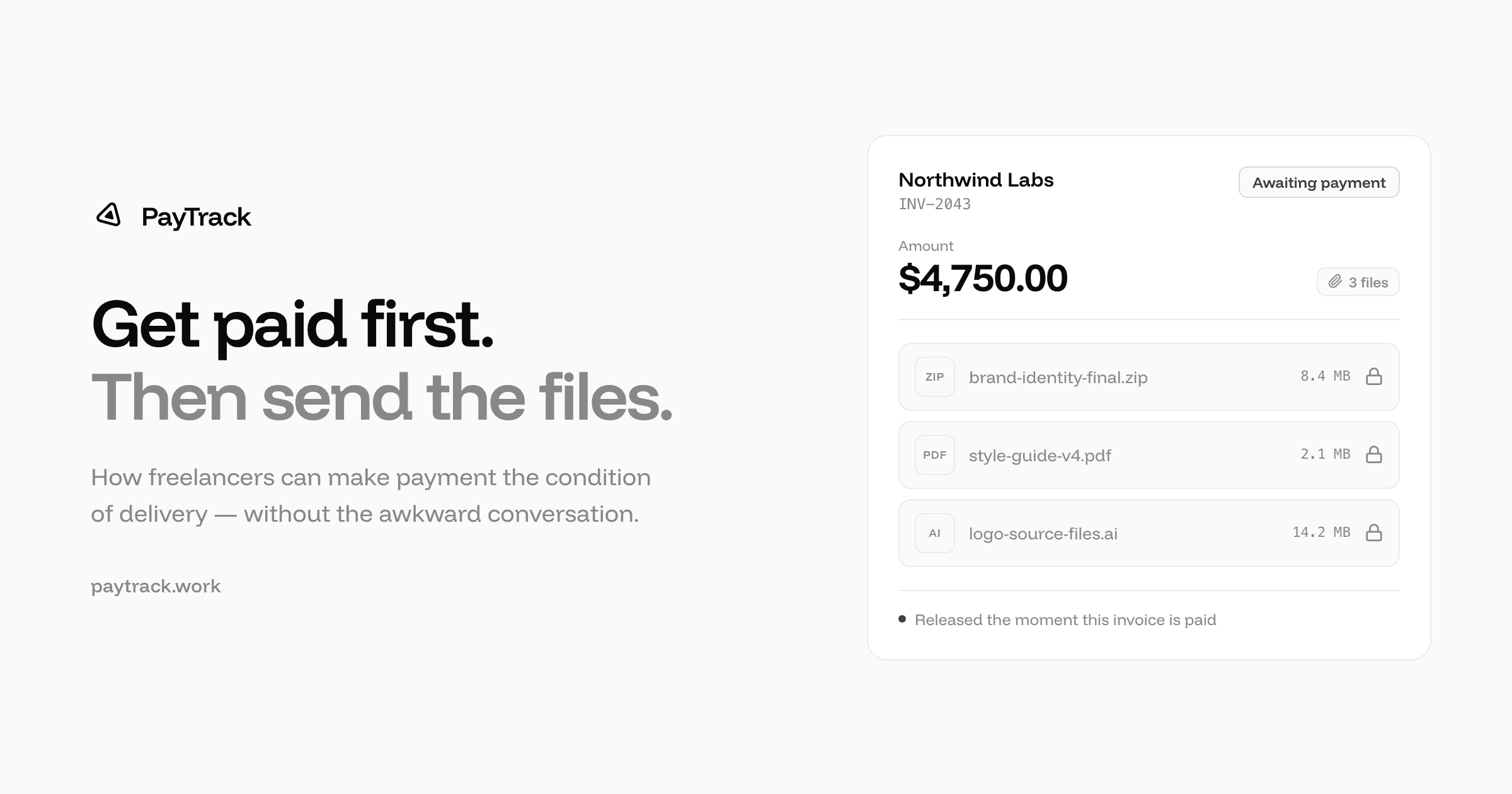
Hand over the files and invoice afterwards, and you have swapped your only leverage for a promise. The fix is not a better chasing email — it is a delivery process where payment comes first: take a deposit, show watermarked previews, and release the final files automatically the moment the invoice clears.
The short version
- Take a deposit, share watermarked previews, and release the production files only once payment clears.
- Withholding deliverables until payment is standard professional practice. AIGA, the Graphic Artists Guild and IPSE all publish contract language for it.
- In the UK and Western Europe, 6–7% of all B2B invoices — roughly 1 in 14 to 1 in 17 — get written off as uncollectable.
- Put the clause in the contract before the project, not in an email after the invoice goes unpaid.
- Deliver previews freely. Gate only the production-ready files.
Delivering first is the weakest position you can take
Every freelancer learns this the same way. The work is approved, you send the final files because the relationship feels good, and then the replies get slower. You are now an unsecured creditor with no asset to withhold, and the only tools left are email, awkwardness and eventually a court.
There is a legal wrinkle that makes this worse than it looks. Under UK law, when no payment date has been agreed, GOV.UK states the payment is late “30 days after either: the customer gets the invoice [or] you deliver the goods or provide the service (if this is later).” The EU’s Late Payment Directive (2011/7/EU) sets the same 30-day default.
Read that carefully. If you invoice on the day you deliver — which is what most of us do — the clock starts the moment the files land. You have given away the work and bought yourself a month of waiting before the debt is even formally late. Everything you can do after that point is slower and more expensive than the thing you could have done before it.
How often does this actually go wrong?
Often enough to plan around, and the honest answer is that the good data measures businesses rather than freelancers specifically.
The credit insurer Atradius surveys B2B payment behaviour every year. In its 2025 Payment Practices Barometer, bad debts accounted for 7% of all B2B invoices in the UK, 6% across Western Europe, and 5% of long-overdue invoices in the United States. Different samples, same order of magnitude: a meaningful slice of invoiced work is simply never paid for.
The scale of the merely-late problem is larger still. Research conducted by London Economics for the UK’s Department for Business and Trade and the Office of the Small Business Commissioner, published in July 2025, found that 28% of businesses are affected by late payments each year, that they are owed around £26 billion at any given moment, and that the average affected business carries about £17,000 of it. The same research attributes 14,000 business closures a year — 38 a day directly to late payment.
For freelancers specifically the evidence is thinner and older. A 2022 survey of New York freelancers by the Freelancers Union and a coalition of creative bodies found that 62% had lost wages at least once to a client refusing to pay, 91% had been paid late at least once, and 39% said non-payment had affected their ability to pay bills or rent. Treat that as directional: it is four years old, geographically narrow, and the organisers did not publish a sample size.
A caution worth passing on. Searching this topic surfaces a lot of confident numbers — “74% of freelancers have experienced non-payment”, “freelancers lose $5,968 a year to wage theft” — that cannot be traced to any primary study. I went looking for the sources and could not find them. Every figure on this page links to the organisation that produced it, so you can check the ones you want to rely on.
Withholding work until payment is standard practice, not a hostile act
The reason most freelancers deliver first is social, not commercial. Asking to be paid before handing over work feels like accusing the client of something. It is worth knowing that the professional bodies in your industry disagree, and have published the contract language to prove it.
AIGA’s Standard Form of Agreement for Design Services puts it plainly, at section 3.4 (Invoices):
“Designer reserves the right to withhold delivery and any transfer of ownership of any current work if accounts are not current or overdue invoices are not paid in full.”
The Graphic Artists Guild’s Letter of Agreement takes the same position from the licensing side — “The Client’s right to use the work is conditioned upon receipt of payment within thirty days of acceptance” — and adds that “Original art remains the property of the Artist unless expressed in the agreement.” In the UK, IPSE’s late payment guide describes the same practice as commonplace: “A common approach for many freelancers is to require a partial deposit, or to set out stepped payments at agreed project stages, or to withhold the final deliverable until payment has been received.”
Three independent professional bodies, three versions of the same clause. If a client pushes back, you are not improvising — you are applying the industry’s own standard agreement.
Five ways to structure payment-first delivery
These five approaches stack. Most working freelancers use two or three at once, scaled to how much they trust the client and how much money is at risk.
1. Take a deposit
A deposit does two jobs: it covers your exposure if the project dies, and it filters out clients who were never going to pay. On the amount, be sceptical of anyone quoting a precise benchmark — I could not find an authoritative study of deposit sizes. 30–50% up front is the convention I see most often in creative work, and IPSE describes a “partial deposit” as a common approach, but treat the specific number as custom rather than evidence.
2. Bill in stages, not at the end
On anything longer than a couple of weeks, tie payments to milestones and make each stage’s deliverable conditional on the previous stage being paid. Your maximum exposure becomes one milestone instead of the whole project.
3. Deliver previews, gate the originals
This is the compromise that avoids most awkwardness. The client sees everything and can approve it: watermarked comps, flattened JPEGs, a staging URL, a low-resolution cut. What they do not get until payment clears is the production-ready asset — the layered source file, the print-resolution export, the repository, the unwatermarked master. You are not withholding the work. You are withholding the version they can use without you.
One caveat that most advice on this is a decade out of date about: a watermark deters, it does not gate. Removal has never been hard and generative tools have made it trivial. Treat the mark as a social signal that says “this is not the paid version”, not as a technical control. If the file would be genuinely usable the moment the mark came off, the mark is not your protection — not sending that file is.
4. Put the kill fee in writing
Cancellation is where undocumented projects turn into arguments. The Graphic Artists Guild’s template is a reasonable benchmark: 50% of the fee if the job is cancelled before the final stage, and 100% if the work has already been completed. Decide this before the project, not during the argument.
5. Attach the files to the invoice itself
The cleanest version of all of this removes the handover step entirely: the deliverables travel with the invoice, and the payment releases them automatically. Nobody has to send an awkward email, because there is no moment where a human decides whether to hand over the files — the payment does it. Full disclosure: this is what I build, so weigh that accordingly. PayTrack attaches files to an invoice and emails them to the client the moment it is paid. You can do the same thing manually with a scheduled upload or an escrow service — the mechanism matters less than removing the discretionary moment.
| Approach | Protects against | Best for |
|---|---|---|
| Deposit | Project dying mid-way | Every new client |
| Milestone billing | Large end-of-project exposure | Projects over a few weeks |
| Watermarked previews | Use without payment | Design, photo, video, copy |
| Kill fee | Cancellation disputes | Commissioned creative work |
| Payment-gated delivery | The handover moment itself | Any digital deliverable |
What to say when they push back
Most advice on this topic stops at “ask for a deposit” and leaves you to invent the wording under pressure. The pushback is predictable enough to prepare for, and it almost always arrives as one of four moves. Short answers work better than justified ones — the moment you explain at length, it reads as negotiable.
| What they say | What to reply |
|---|---|
| “Can you send the files without the watermark? We just want to show the team.” | “The watermarked version is fine for review — everyone can see the work. Clean files go out as soon as the invoice clears.” |
| “We’re definitely paying, we just need sign-off first.” | “No problem — sign-off works fine on the preview. I’ll release the finals the moment payment lands.” |
| “The watermark makes it look unprofessional.” | “Understood, and it comes off at payment. Sending it before then is what makes the invoice optional.” |
| “Don’t you trust us?” | “It’s not personal — it’s how I run every project. It’s in the agreement we both signed.” |
Notice what all four replies have in common: none of them argues, none of them apologises, and every one restates the same fact without heat. You are not asking permission. You are describing a process the client already agreed to, which is exactly why the clause has to be in the contract before any of this comes up.
Where the line actually is
Withholding work you still own is exercising your contract. Pulling down a site that is already live, deleting a client’s data, or disabling something they depend on to trade is a different act entirely — it interferes with their business, and it can rebound on you legally whatever the invoice says. Not handing something over and taking something away are not the same thing, and the difference matters more than the unpaid balance.
Check the client before you start
If your client is a large UK company, their payment record is a matter of public record and almost nobody looks it up. Under the Reporting on Payment Practices and Performance Regulations 2017, large businesses must publish how long they actually take to pay. You can search any of them at check-payment-practices.service.gov.uk.
It is worth knowing what “normal” looks like there. Across 11,178 statutory returns for 2025, large UK businesses paid their suppliers in a median of 32 days, with 15% of invoices paid late. A prospective client sitting well outside that range is telling you how your invoice will be treated, before you have written a word of the proposal.
What if you have already delivered and they will not pay?
The leverage is gone, but the options are not. In rough order of escalation:
- Charge the statutory interest. In the UK you are entitled to 8% plus the Bank of England base rate on late commercial debt. The EU directive sets a comparable floor of at least eight percentage points above the reference rate, plus a minimum €40 in recovery costs. You do not need it in your contract; it is statutory.
- Withdraw the licence, not just the files. If your contract conditions the client’s right to use the work on payment — as both the AIGA Standard Form of Agreement and the Graphic Artists Guild Letter of Agreement do — then continued use of unpaid work is a separate problem for them. That is a more serious letter than “just following up”.
- Check your local statute. Freelancer-specific protections are spreading. New York’s Freelance Isn’t Free Act requires a written contract at $800 or above — counting either a single job or everything you have billed that client in the preceding 120 days — sets payment at 30 days after completion where no date is specified, and provides for double damages plus attorney’s fees. In the same 2022 survey above, under 1% of freelancers had used the legal system at all — these protections are badly underused.
All three are recovery. None is as effective as not being in the position, which is the whole argument for taking a deposit and gating delivery.
Common questions
Will asking for payment first cost me the client?
Sometimes. Deposits and staged payments are documented as common practice by IPSE and built into the AIGA and Graphic Artists Guild template agreements, so established clients are unlikely to find the request unusual. My own experience is that the loudest objections come from the clients who go on to pay worst — but that is a pattern I have noticed, not something I can point to a study for.
Is it legal to withhold finished work?
If your contract says so, generally yes — which is exactly why the AIGA and Graphic Artists Guild templates contain the clause. The risk is withholding work when your contract already transferred ownership or granted an unconditional licence on completion. Put the condition in the agreement up front. This is general information rather than legal advice, and the specifics vary by jurisdiction and contract.
My client is a big company on Net 30. They cannot pay a deposit.
This is the strongest objection to everything above, and it is usually true. Large organisations and public bodies run on procurement cycles and purchase orders; there is often no mechanism to cut a cheque before delivery, and the person you are talking to genuinely cannot override it. Insisting on a deposit there will cost you the work rather than protect it.
What travels to that world is the rest of it. Get the purchase order issued before you start — a PO is the enterprise equivalent of a deposit, in that it commits the budget. Bill in stages against milestones so your exposure is one increment rather than the whole engagement. Keep the licence conditional on payment even when delivery is not. And look the client up: if their published payment record says 70 days, plan your cash flow for 70 days rather than the 30 on your invoice.
What about existing long-term clients?
Change terms at a natural boundary — a new project, a new year, a rate change — rather than mid-engagement. Framing it as a change to how you work generally, rather than a reaction to them specifically, removes almost all of the friction.
How much deposit should I ask for?
There is no authoritative benchmark here. 30–50% up front is the range I see most often in creative work. Weight it higher for a new client, a tight deadline, or work that is useless to anyone else if the project dies.
The one change worth making this week
Add a withholding clause to your contract template. Borrow the AIGA wording — it took a professional association and its lawyers to write, and it is published for exactly this purpose. Then, on your next project, send a watermarked preview instead of the final files and see how little anyone objects.
Somewhere between 1 in 14 and 1 in 17 B2B invoices in the UK and Western Europe is written off as uncollectable. You cannot control which of your clients falls into that group. You can control whether they already have the files when it happens.